July 25, 2011

Templated!

Not too long ago, I was trying to decide whether or not to make myself templates for the bee blocks I've been developing. I waffled instead of working - quelle suprise - for a few days, and, suddenly, one night, I wondered, "How long would it take to make templates for these blocks?"

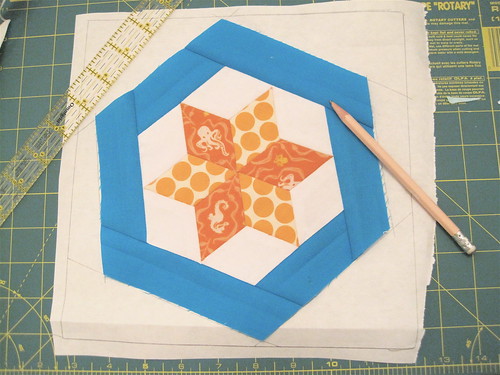
Curiosity is a strange motivator, because about 5 minutes later, I'd used one of my bordered hexagons as a guide for drafting some pattern pieces on freezer paper.


It was all very high tech, as you can see.


Freezer paper templates are nice, because you can just iron them to the right side of the fabric and use a ruler to add a seam allowance before cutting.

(At least, that's the only way I can make them work!)

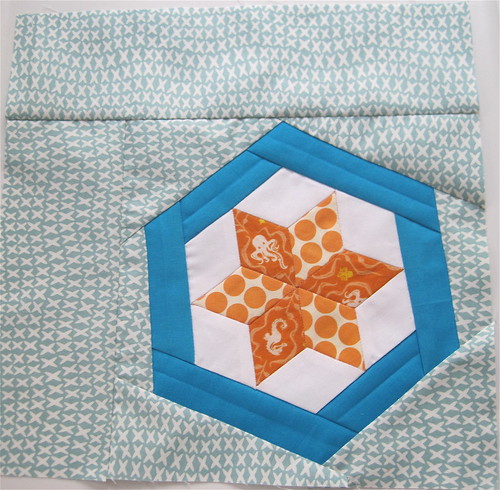
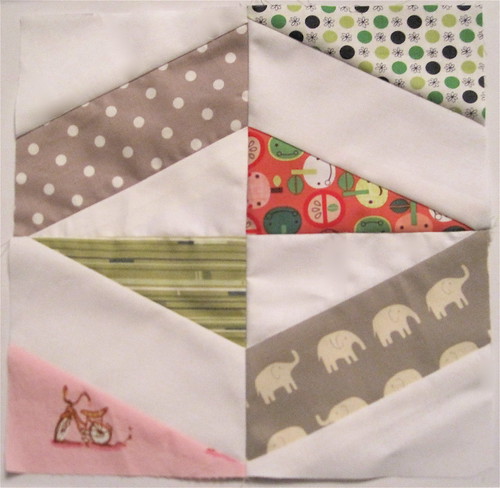
Here is the finished block:


SO much easier with templates.

I should have blogged this sooner, but the heat wave basically fried my brain, making me forget I'd made any progress. It also kept me out of the hot, hot sewing room, so this week I'll need to buckle down and make some real progress on these bee blocks, since 3x6 starts on August 1st!

July 18, 2011

Gone hexin'...

back in three days.


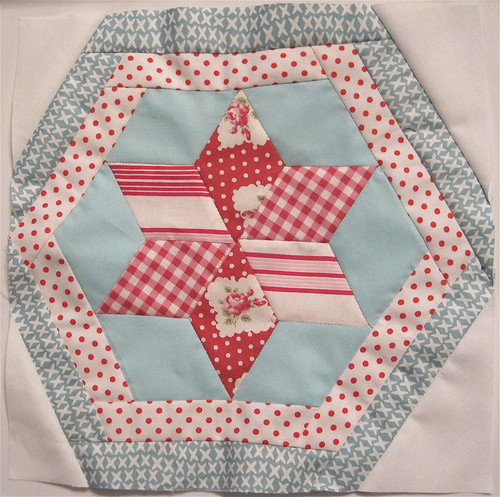
Okay, maybe not, but I've really enjoyed hiding out from this officially Too Darn Hot weather making hexagon stars for the 4x5 bee. They're hand-stitched, which takes forever, but they don't feel like they take forever, which is basically ideal when it comes to a summer project. Lots of hours with an audiobook or The Tudors, no boredom to force me out into the heat.

If only I could eat some of my fabric stash instead of shopping or cooking - this could be the best, hexiest summer ever.

July 15, 2011

Non-disaster strikes!


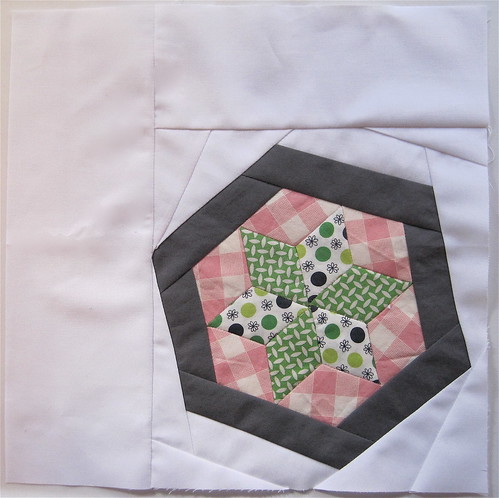
Well, my hexy star block hasn't been perfected just yet, but I have achieved a 12.5", non-wobbly, non-disaster. I used smaller diamonds, to start with, and that put me on the right track for creating the "offset" look I'd envisioned - it's really hard to offset something that takes up most of the block.

Consulting the tutorial over at Sew Lux was definitely helpful - our hexes weren't the same size, so I had to augment with some extra triangles, but it was definitely a start. Her suggestion to add border strips on opposite sides of the hex turned out to be particularly effective in not stretching out all of my careful hand-piecing.

Now I'm wrestling with whether or not I should continue to wing it when piecing the outer borders, or just be responsible and make some freezer paper templates.

Decisions, decisions.

July 13, 2011

Bee Blocks: Trial Runs

I decided to try out a couple of blocks for upcoming bees: the famous [3x6] bee, and its new sister bee, 4x5.

I'm glad I did, because there were, well, issues.


That's the star block I made, and... I don't even know what to say about it. I'd pictured it differently in my head, and so of course it's my own fault for not following my vision more carefully. Needless to say, I've started this one over.


The Left and Right block, which you may know from Quilter's Cache, may look promising, but it was a little fiddly. The main problem was that I make paper piecing templates out of tracing paper, which comes in 9" x 12" sheets. For each quarter, I used a 6" square of tracing paper, cutting two from each sheet in an attempt not to be wasteful. But to get a the 12.5" square block that's the requisite size for bees, I really needed 6.5" quarter blocks, and adding a .25" seam allowance to all sides is actually pretty tricky when angles are involved.

But since I'm happy with the way it came together, I think I'll use it for the next round of the [3x6] bee. Only I'll go easy on myself, reducing each quarter template to 4.5" and adding a bit of a border. Stay tuned for another trial block.

In the meantime, even though these aren't so perfect, they are giving me a head start on some sampler quilts!

June 24, 2011

Teacup Tutorial

Once again for the [3x6] Sampler Quilt Mini Bee, I decided to modify some ideas into a block of my own design.

The advantage here is that I don't have to worry about making the same blocks as anyone else. The disadvantage is that, when someone compliments the block, I can't just toss them a link to some tutorial. Until I write said tutorial myself, that is.

So here's an attempt to help you make your own 12" teacup block.
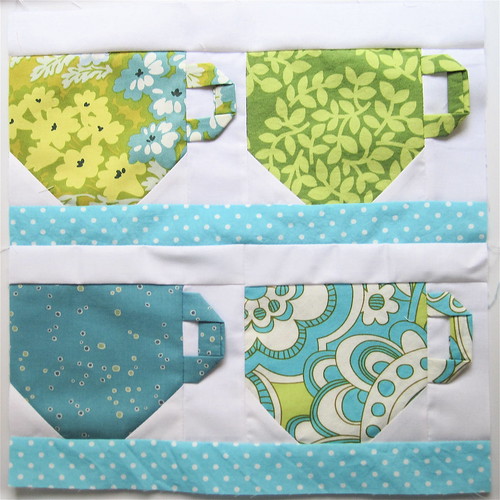


A couple of notes:
  • I didn't take pictures of every single step. So sorry! Rest assured, this is a simple block.
  • Some tea cups will "change color" throughout the post. This is the unfortunate result of me being a tad late with my blocks this round, and having to snap pics during a furious assembly line process.
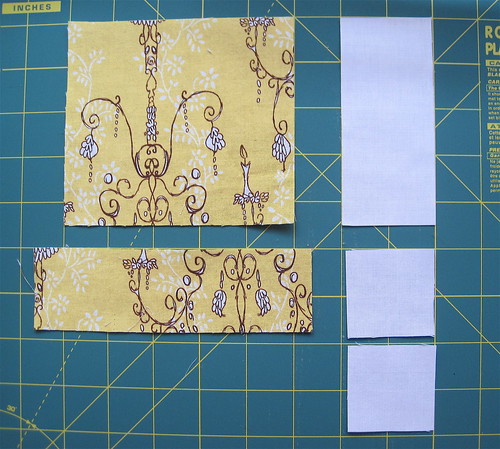


For your tea cup and handle, you'll need:
  • 1 print rectangle, 4.5" x 5"
  • 1 print rectangle, between 1.25" and 2" wide, at least 4" long
  • 1 white (or background) rectangle, 2" x 4.5"
  • 2 white (or background) squares, 1 7/8"
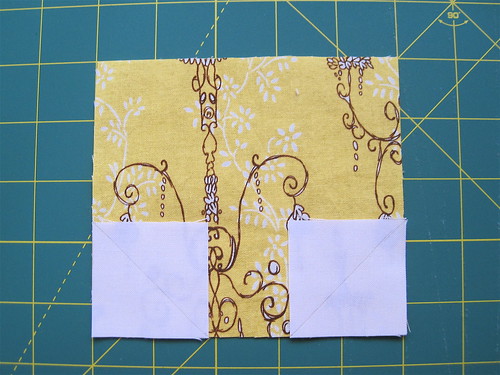


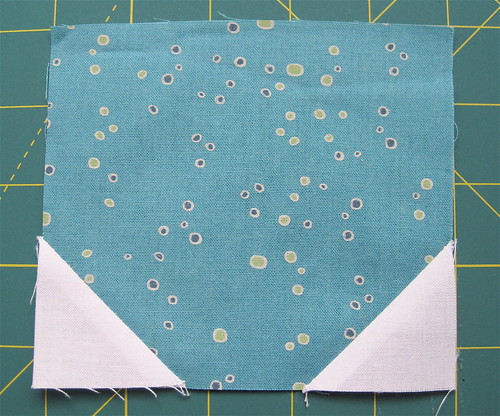
Use a pencil or water-soluble pen, draw a line from corner to corner across each 1 7/8" square. Place the squares on the bottom corners of the 1 print rectangle, 4.5" x 5", as shown, making sure edges are aligned. Pin if desired. Sew carefully along the pencil lines.


Using a ruler, trim off both corners .25" from the seams. Fold down the white fabric and press. You have just created the curved bottom of a tea cup! See?


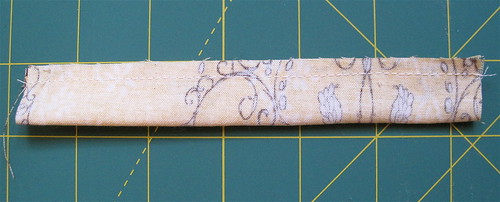
Take the remaining print rectangle and fold it longways with the right sides together. Sew .25" from the raw edge to make a tube:


I like to make the tubes varying widths.
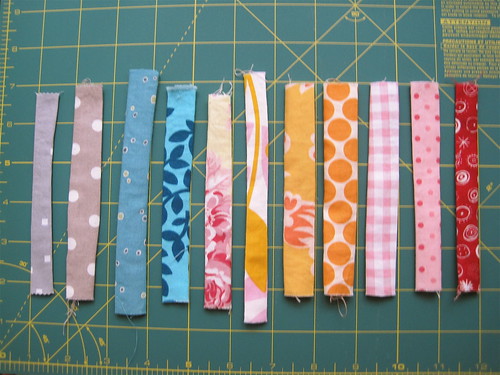


Mostly because it's easier that way. Use a turning tool to turn the handle so the right sides are facing out, and press to get nice, crisp edges.

To attach the handle to the rest of the cup, line up the 2" x 4.5" rectangle to the right of the pieced cup unit.
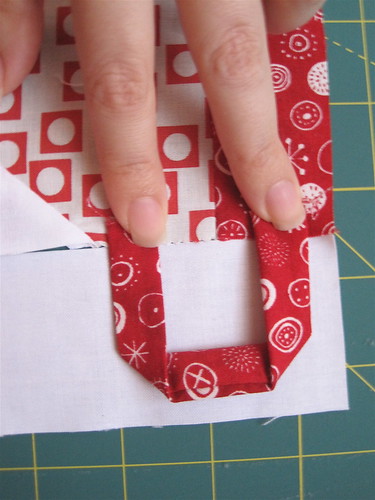


Fold the handle piece into a "u" shape until it resembles a cup handle of your liking. Pardon my (lack of) manicure.
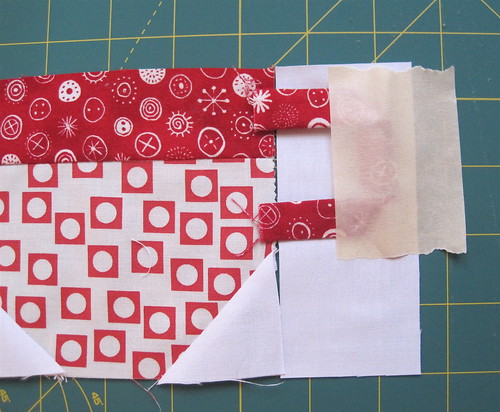


Pinning would be fiddly at this point, so I just stick the handle to the background rectangle with a bit of masking tape. As long as you keep the tape out of the seam allowance, it won't interfere with sewing.

You can see how I kept excess handle fabric to the left of the background rectangle, where it will get caught in the seam and can be trimmed later.

Sew, trim, and press, and TA-DA!
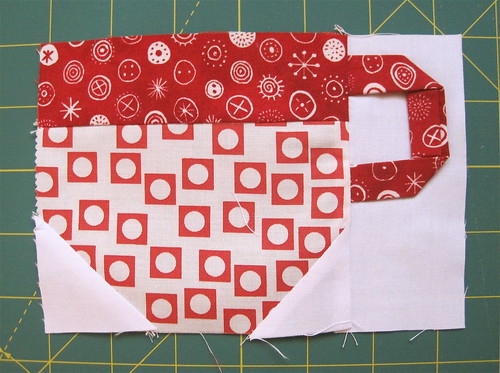


To turn four 4" x 6" teacup units into a 12"-block, arrange them into two rows and attach them like so:
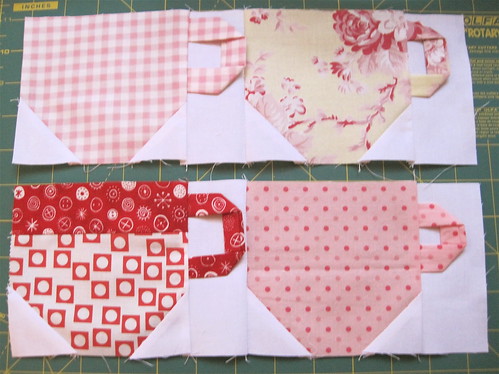


To EACH of these units, sew one white (or chosen background fabric) strip of fabric 1.5" x 12.5" to the top of the unit, and a strip of the same size in your chosen shelf fabric to the bottom of the unit.

Then, stack the units and sew them so they look like this:
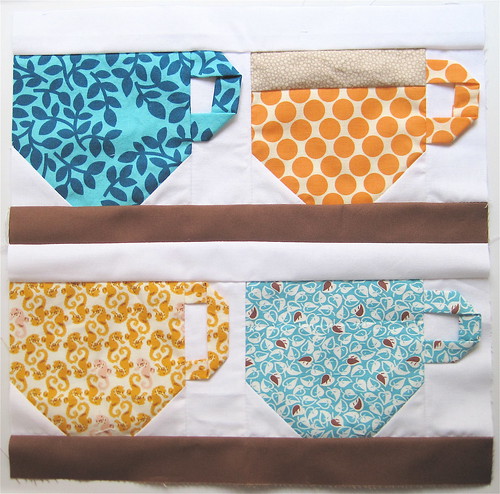


Of course, you can make a 6"-block by adding 1.5" x 6.5" strips to the top and bottom of one cup unit, but I was aiming for a 12"-block, and the appearance that the cups were together in a cabinet or on shelves together.

Handles can be appliqued down, tacked down, quilted down, or left to flap freely in the wind!

Please leave a comment with any questions or concerns!

June 21, 2011

Busy Bee

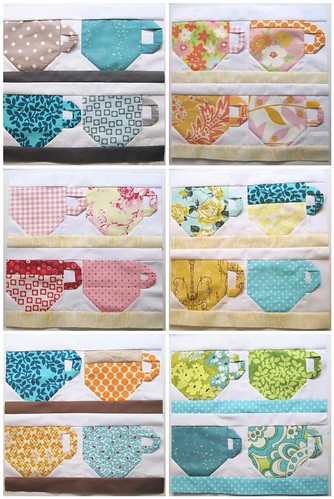
Okay, the truth is, I haven't posted because I was on vacation. And then I got back, and I had to get busy. See?


Tutorial coming soon!